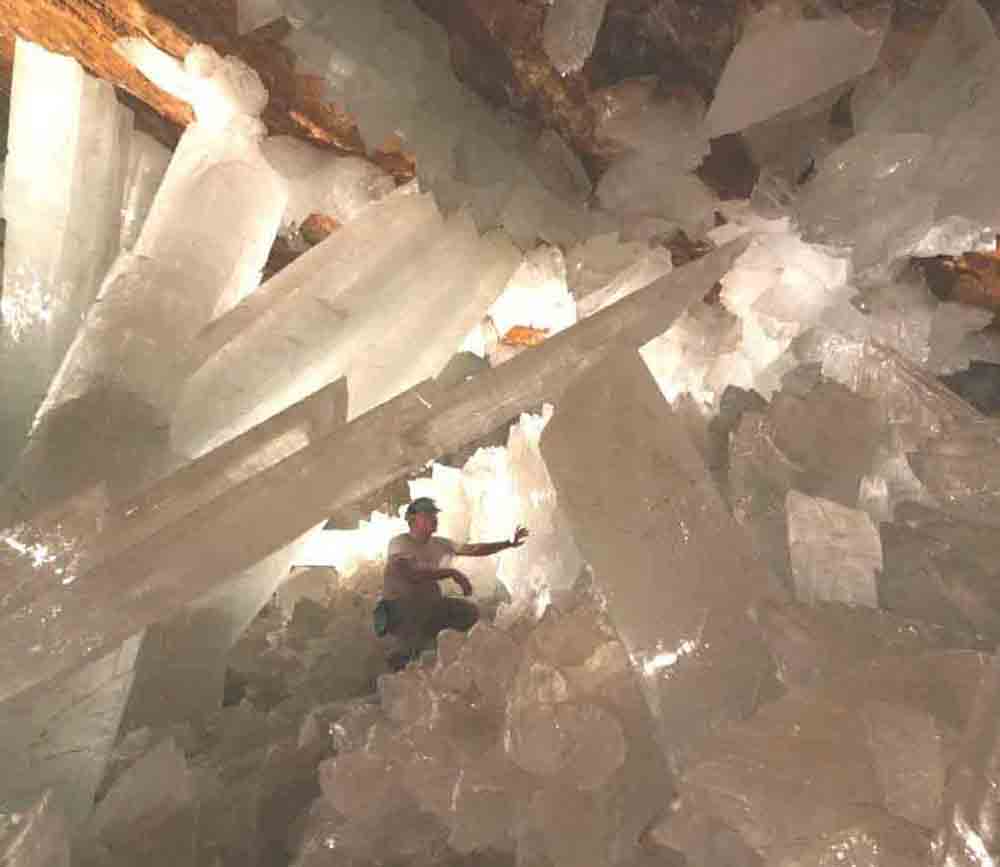
“Naica Peñoles Project, the Cave of The Crystals”
A forest of crystals, the biggest ones on the Planet.
An unreal world, beyond imagination, beyond dream.
A cave with a temperature of 50° C and 100% humidity; an infernal place, where man can survive just a few minutes. Still unexplored.
A wonder of nature discovered by chance, fragile and mysterious; something we risk to lose at any time.
And that will soon turn inaccessible again, hidden in the heart of the Earth. Naica’s Crystals Cave is a small window onto the immense geological time; a window man can now open thanks to a new, exclusive technology.
A high risk «astronautics» exploration, beyond human limits, in order to understand, study, document and save. Before it becomes too late. In January 2006 the Geographical Association La Venta, an international team of cavers and researchers who have carried out successful explorations in several areas of the planet, from Antarctica to central Asia, was entrusted by the Peñoles mining company, sole licensee of the mine, to implement a research project on the cave for the next three years. Not only in this particular cave but also in several similar caves which were found in the same mine and still totally unexplored.
The area
The cave opens in a semi-desert area of the Naica Mountains, a hundred kilometers southeast of Chihuahua, capital city of the homonymous Mexican state at the boundary with USA.
These mountains are 200 million old limestone massifs hosting networks of caves eventually crossed by very deep hot and mineralized thermal waters. Such waters reached these relatively colder – and closer to the surface – environments and deposited part of their salt content. During millions of years the caves filled with mineralizations mainly rich in lead, silver and zinc.
These mineral veins were exploited since the end of the 19th century; the Naica mines are still the most important in Mexico and among the main ones in the world.
The caves
In 1910, during the mining works, what was then called the Cueva de las Espadas (Swords Cave) was discovered; this was a single 80 m diameter great hall 120 m below the surface. Its basic feature was being filled with big gypsum “prismatic” crystals (gypsum macrocrystals are generally called “selenite“) reaching 2 m in length and 25 cm in diameter, that underwent mineralogical exploitation. As a matter of fact most macrocrystals of this kind exposed at the present time in the mineralogical museums of the world come precisely from this cave.
This exploitation has damaged the cave in two different ways: it deprived it of its best pieces on one side, and radically modified the microclimate features on the other. As a consequence, the remaining crystals have turned dusty and opaque.
In April 2000 the excavation of a communication tunnel three hundred meters below the surface unveiled the presence of the Cueva de los Cristales (Crystals cave) containing the world’s biggest and purest gypsum crystals ever found, reaching up to 10 m in length and 2 m in diameter.
Crystals Cave
The first move was to arrange the entrance stretch of the cave, cementing the floor and placing electric lights. Then, the negative experience coming from Swords Cave, the potential huge value of the macrocrystals on the mineralogical market and their basic fragility suggested the mine direction a radical protection policy of this authentic jewel of the subterranean world. The visit to the cave is not permitted unless in case of documented research projects aiming at studying the crystals and conserving the cave environment, that appears difficult on a time scale of a few tens of years.
This is why the cave has only been explored for a few tens of meters. The main difficulty is anyway represented by the environment: the air temperature was in fact calculated at 60°C and the humidity at 100%; the cave seemed to need no help toprotect itself .
The crystals genesis
The macrocrystals formed underwater, in a place where the hot (52°C) and sulphur saturated deep thermal waters got in touch with external cold waters rich in oxygen, that naturally infiltrated from the surface.
Along the surface separating these waters, that could not melt directly due to the different (higher) density of the deep mineralised ones, oxygen “diffused” into the lower layer with consequent oxidation of sulphur and sulphate ions, that caused an extremely light over-saturation of gypsum and therefore its slow deposit.
These conditions evidently lasted for a very long period of time (thousands of years) and the crystals had the possibility to develop to such incredible sizes. Finally, in recent times, the cave emptied naturally following the drawdown due to the mining activity.
The microclimate
During our survey (October 2002) we were able to stay inside the cave longer than usual and use precision Testo thermometers. So we could determine the cave temperature at 47.10°C at floor level and 47.38°C two meters higher. The temperature therefore increases of approx. 1/10 of degree per meter of height. The air is saturated with humidity.
The technical difficulty
The temperature itself does not seem to be exceptionally high, and in fact in some outer areas it may be widely overcome: the highest temperature data measured in a free atmosphere were 58°C in El Aziz, Libia, in 1922 and 57°C in the Death Valley, California, in 1913. Saunas may then widely overcome these values, getting beyond 100°C. The fact is that in such conditions the air is extremely dry and therefore the human body may keep a normal skin temperature thanks to a continuous evaporation allowing the survival for a fairly long time.
If the air grows richer with steam the situation modifies radically. On one side the evaporation mechanism stops working so that one becomes unable to get rid of the heat. On the other, much more seriously, the skin and the inside of the lungs work as “cold walls” on which the steam starts to condense discharging huge amounts of energy. In a sauna we may test this terrifying effect at a lower scale when water is spread on the hot stones: the air remains extremely dry, but the thin layer on our skin may turn over- saturated and condense.
As a result, we suddenly feel burning: the temperature has not varied (on the reverse, it has decreased) but the mechanism that kept us “cold” gets cancelled for a second and we perfectly realize which kind of hellish environment we are in.
In other words, staying in an atmosphere saturated with humidity at temperatures higher than 35-37°C is the same as being plunged in flowing water at that temperature and is therefore rapidly lethal.
The highest acceptable temperature of water in which to plunge completely ranges between 40 and 42°C; beyond this value we consider it absolutely unbearable.
The temperature of Crystals Cave is exactly so: unbearable, and the first impact is even worse.
The technique
One may resist half-naked at that temperature for 3-5 minutes, due to the fact that it takes the heat a little bit of time to steam us and that the skin temperature is kept at bearable levels by the flux of “cold” blood coming from the inside of our body thanks to a huge peripheral vasodilatation. The situation is then unstable and above all makes the heart undergo a tremendous effort, like during a desperate run.
A short time after the discovery of the cave a miner entered the cave secretly to steal some crystals and fainted; when he was found, a few hours later, he looked literally steam cooked.
The aim of our first survey was to know the environment and test a slightly different approach from the traditional way to enter half-naked: the idea was to protect ourselves as much as possible, to keep the heat flux from reaching the skin. We believed in this way it would be possible to resist for a much longer period of time, and in fact one of us stayed in the cave for almost half an hour.
On the other side, we feared that long exposures could cause serious trouble to the lungs, as “cold walls” on which the steam would condense with the double effect of boiling and filling them with water. Therefore we built some breathers in which the air would cool before reaching the lungs.
The instruments
The main problem of the instruments (photographic equipment and a 1/100°C thermometer) was related to the fact that they might be used only after reaching the ambient temperature, and that before reaching it they would be dripping wet with condensate, not only on the outside but most probably also on the inside.
The final result was a little damage on the thermometer display and no evident damage of the photographic equipment: all this, of course, was a pleasant surprise for us.
Our main mistake was to underrate the time needed by the instruments (especially the D100, with a bigger mass) to reach the ambient temperature. The Coolpix and the Testo thermometer equilibrated in little less than one hour, but the D100 would have needed at least two hors.
The future
At the present time we are working to start a research project to complete the exploration of the cave and determine its vulnerability. Therefore we are developing breathing and protection systems allowing us to remain inside the cave for at least one hour.
now look at supermans fortress of solitude….
wow…..